
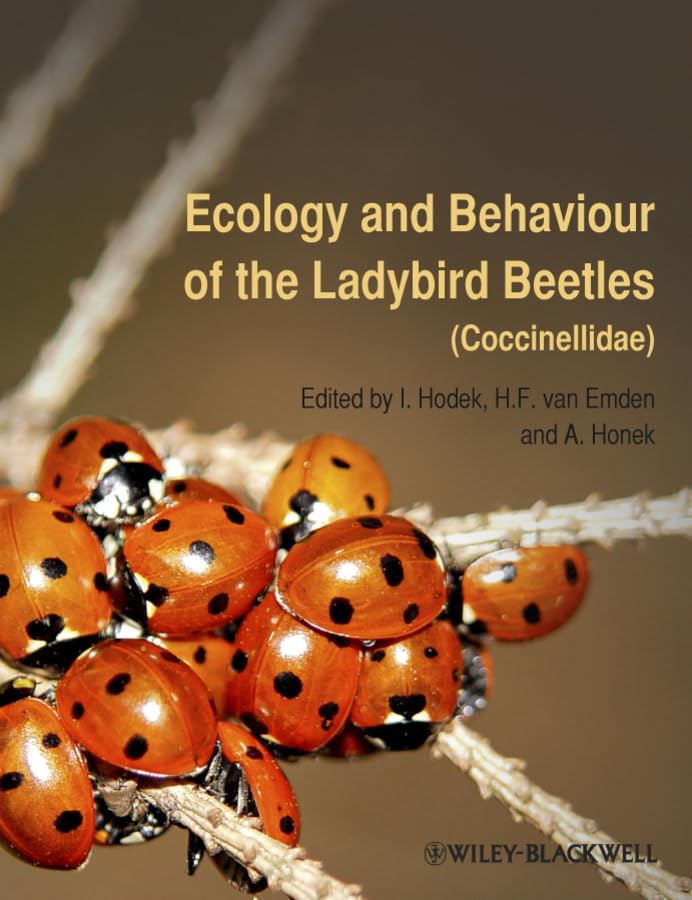
Ecology and behaviour of the ladybird beetles (Coccinellidae)/ edited by I. Hodek, H.F. van Emden, and A. Honeˇk.
Material type: TextPublication details: Hoboken: Wiley-Blackwell, 2012.Description: xxxvii, 561 p.: ill.; 26 cmISBN:
 - ISBN 978-1-4051-8422-9
- DUCE QL596.C65E26
| Item type | Current library | Collection | Call number | Status | |
|---|---|---|---|---|---|
| Books | DUCE LIBRARY Science: Shelf QB461.A773 – QC981.T65 | Science Collection | DUCE QL596.C65E26 (Browse shelf(Opens below)) | Available |
Browsing DUCE LIBRARY shelves, Shelving location: Science: Shelf QB461.A773 – QC981.T65, Collection: Science Collection Close shelf browser (Hides shelf browser)

|
|
|

|

|

|
|
||
| DUCE QD79.15 S39 Chemistry experiments for instrumental methods/ | DUCE QD79.15 S39 Chemistry experiments for instrumental methods/ | DUCE QD79.15 S39 Chemistry experiments for instrumental methods/ | DUCE QL596.C65E26 Ecology and behaviour of the ladybird beetles (Coccinellidae)/ | DUCE QC .174.2.L52 Introductory quantum mechanics / | DUCE QC 21.3.B45 Concepts of modern physics / | DUCE QC 21.3.B45 Concepts of modern physics / |
Includes bibliographical references and index
Ladybird beetles (family Coccinellidae), commonly known as ladybugs, are ecologically significant insects widely distributed across terrestrial ecosystems. They play a crucial role as biological control agents, primarily preying on aphids, scale insects, mites, and other soft-bodied arthropods. Their ecology is closely linked to habitat type, prey availability, climatic conditions, and seasonal changes. Ladybird beetles occupy diverse habitats including agricultural fields, forests, grasslands, and urban gardens, where they contribute to regulating pest populations and maintaining ecological balance.
Behaviorally, ladybird beetles exhibit distinct patterns related to feeding, reproduction, dispersal, and overwintering. Many species demonstrate strong prey-searching abilities, guided by chemical and visual cues. Aggregation behavior is common during overwintering, providing protection against harsh environmental conditions. Their life cycle consists of complete metamorphosis—egg, larva, pupa, and adult—with both larvae and adults often being predatory. Some species display aposematic coloration and chemical defenses to deter predators.
There are no comments on this title.