
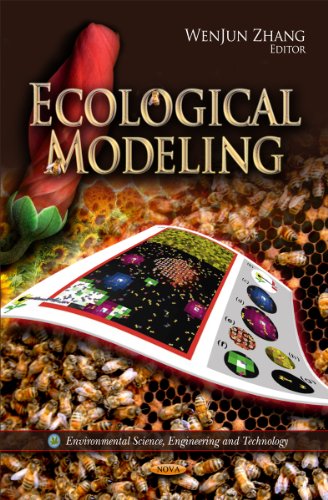
Ecological modeling/ By WenJun Zhang
Material type: TextPublication details: New York Nova Science Publishers, 2012.Description: xiii, 405 p. : ill. ; 27 cmISBN:
 - 9781613245675
- DUCE QH541.15.S5 E275
| Item type | Current library | Call number | Status | |
|---|---|---|---|---|
| Books | DUCE LIBRARY Science: Shelf QH47.C68 – QH583.2.C45 | DUCE QH541.15.S5 E275 (Browse shelf(Opens below)) | Available |
Browsing DUCE LIBRARY shelves, Shelving location: Science: Shelf QH47.C68 – QH583.2.C45 Close shelf browser (Hides shelf browser)

|

|
No cover image available |

|

|
|
|
||
| DUCE QH541.2.K374 How to do ecology: a concise handbook/ | DUCE QH541.5S3B34 An introduction to marine ecology / | DUCE QH541.15.M3 Theoretical ecology: principles and application / | DUCE QH541.15.S5 E275 Ecological modeling/ | DUCE QH541.24 Experiments in ecology : their logical design and interpretation using analysis of variance / | DUCE QH541.24 Experiments in ecology : their logical design and interpretation using analysis of variance / | DUCE QH541.24 U54 Experiments in ecology : their logical design and interpretation using analysis of variance / |
Includes bibliographical references and index
Ecological modeling is a quantitative approach used to understand, simulate, and predict the structure and dynamics of ecological systems.
By integrating mathematics, statistics, and computational techniques, ecological models represent interactions among organisms, populations, communities, and their environments.
These models range from simple analytical frameworks, such as population growth equations and predator–prey systems (e.g., the Lotka–Volterra equations),
to complex, spatially explicit simulations that incorporate climate, land use, and biogeochemical processes.
Ecological modeling plays a crucial role in addressing contemporary environmental challenges, including biodiversity loss, habitat fragmentation, climate change impacts, and resource management.
Models are used to test ecological hypotheses, forecast species distributions, evaluate ecosystem services, and inform conservation and policy decisions.
Advances in remote sensing, geographic information systems (GIS), and machine learning have enhanced model accuracy and scalability
There are no comments on this title.